
Trying to figure out if the Omaha real estate market is working for you or against you right now? The January 2026 numbers tell a clear story — and if you are thinking about selling in Douglas or Sarpy County, this data matters more than anything your neighbor is telling you at the mailbox.
This is the January 2026 Omaha real estate market report, built from Great Plains Regional MLS data covering Douglas and Sarpy counties. Here is what the numbers actually say. This is Connie Betz’s Omaha Market Intelligence Report — proprietary MLS data covering Douglas and Sarpy counties, published monthly.
🔍 Tap or click the image to zoom in for full details
What the January 2026 Omaha Real Estate Market Numbers Say
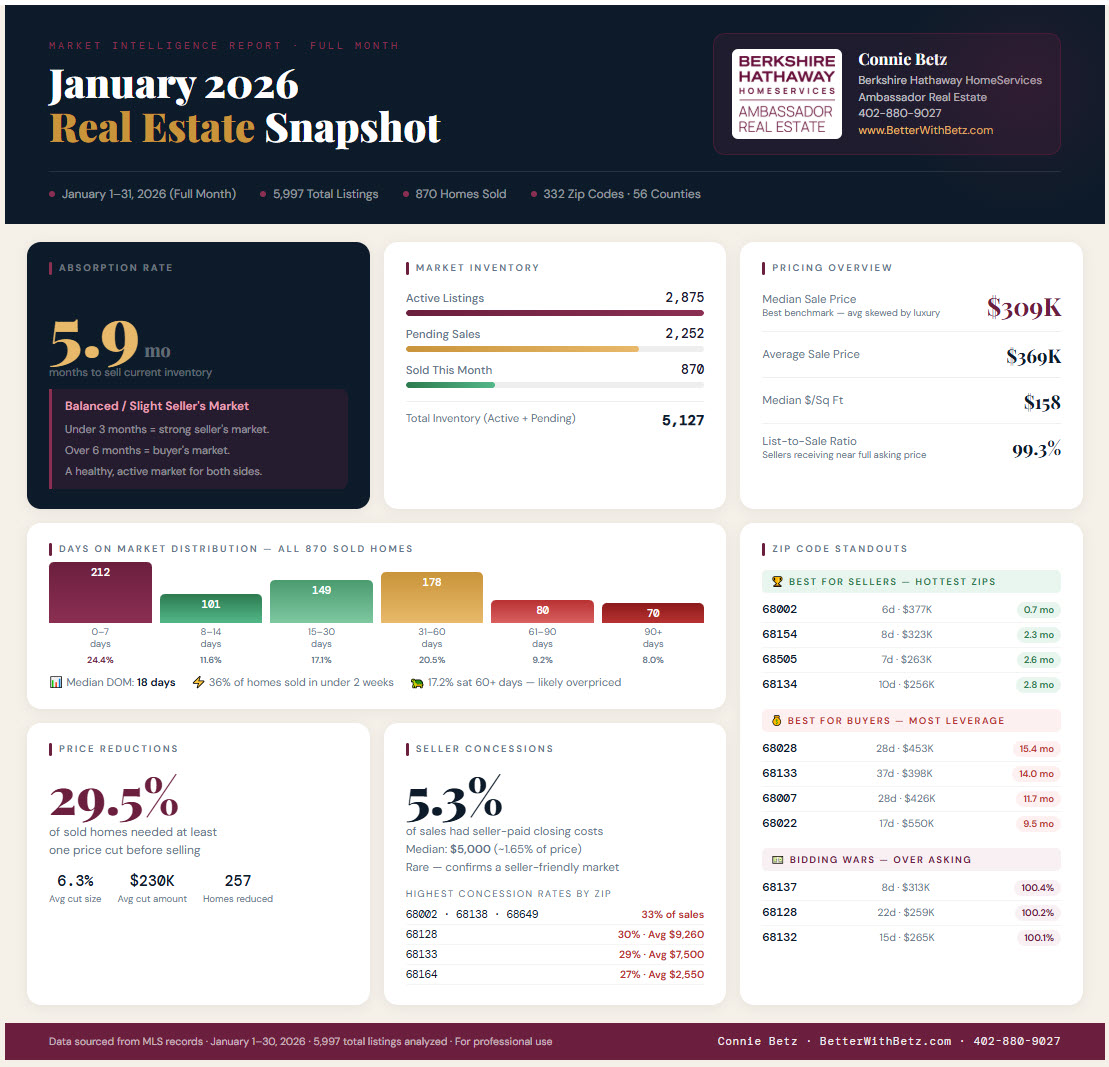
The market opened 2026 in balanced-to-slight-seller’s-market territory. That is actually the healthiest place for it to be. Here are the headline numbers:
- Median sale price: $309,000
- Median days on market: 18 days
- Absorption rate: 5.9 months
- Sale to list ratio: 99.3%
- Homes with at least one price reduction: 29.5%
Sellers are still getting 99.3% of their asking price when they price correctly. Homes are moving in 18 days at the median. Neither of those numbers suggests a market in trouble. What the 29.5% price reduction stat tells you is that the market has zero patience for overpricing. Price it right and you are in great shape. Price it wrong and you are chasing the market down — and every week you sit, your negotiating position weakens.
What a 5.9-Month Absorption Rate Means for Omaha Sellers
The absorption rate is the number that tells you who has the leverage in any given market. Under 3 months strongly favors sellers. Over 6 months favors buyers. At 5.9 months, Douglas and Sarpy counties are sitting right on the edge of balanced — close enough to seller territory that a well-priced, well-presented home still commands strong offers.
This is not 2021 when you could list anything at any price and get 20 offers in 48 hours. But it is also not a buyer’s market. Sellers who treat it like 2021 are the ones generating price reductions. Sellers who price based on comparable sales data and present a clean, move-in ready home are still getting results.
My data IS my advantage — and yours when we work together. Most agents are quoting national averages or metro-wide generalizations. The numbers above come from our proprietary MLS dataset covering 18 months of Douglas and Sarpy county transactions. That is the difference between generic advice and a pricing strategy built on what is actually happening in your zip code.
The Zip Code Story — Not Every Neighborhood Is the Same Market
The metro-wide numbers are a starting point. Where it gets specific — and where sellers can actually use this information — is at the zip code level. January 2026 showed a wide spread across Douglas and Sarpy counties.
Seller advantage zip codes: Areas like 68002 and 68154 were moving in under 8 days with minimal inventory. In these zip codes, a correctly priced home was generating competitive offers fast. Sellers in these areas had real leverage in January.
Balanced to buyer-leaning zip codes: Areas like 68028 and 68133 were sitting at 14 to 15 months of inventory. That is buyer territory. Sellers in these zip codes needed sharper pricing and better presentation to compete. The gap between a well-prepared listing and a poorly prepared one was measured in thousands of dollars.
This is why zip code data matters more than metro averages. Two sellers in Omaha, Nebraska in January 2026 could have had completely different experiences depending on which side of this divide their home sat on. If you want to know where your specific address falls, get a free home valuation here and I will pull the numbers for your street.
What the Price Reduction Data Is Really Telling Omaha Sellers
Nearly 3 in 10 homes that sold in January needed at least one price cut before finding a buyer. That is not a market crash signal. That is a pricing discipline signal.
The buyer is not paying for your memories. The seller takes those with them. What the buyer is paying for is comparable value — what similar homes in similar condition in similar locations have sold for in the last 90 days. When a seller prices above that line, the home sits. When it sits, buyers assume something is wrong with it. When buyers assume something is wrong, offers come in lower than they would have on day one.
The sellers who avoided price reductions in January were the ones who came to the table with data, not sentiment. According to NAR existing home sales data, correctly priced homes consistently outperform overpriced homes that eventually reduce — even when the final sale prices end up similar. The difference is time on market, carrying costs, and negotiating position.
How Buyers Were Financing in January 2026
Understanding how buyers are financing tells sellers something important about who is walking through the door. In January 2026 across Douglas and Sarpy counties:
- Conventional financing: 55% of sales
- Cash: 22% of sales
- FHA: 11% of sales
- VA: 9% of sales
Cash buyers at 22% is significant. Cash offers close faster, have no financing contingency, and remove the appraisal risk that comes with financed offers in a competitive market. If you receive a cash offer at or near asking price in this market, take it seriously. The certainty of a cash close is worth something.
VA buyers at 9% is a reminder that Omaha’s proximity to Offutt Air Force Base keeps military relocation active in this market year-round. VA financing is strong financing — sellers who reject VA offers based on outdated assumptions about VA appraisals are leaving qualified buyers on the table.
A Real Example From the January Market
To put these numbers in context: a brick split-level in the Rockbrook neighborhood at 10145 Hansen Avenue went under contract at $250,000 — priced to reflect its as-is condition in a neighborhood where updated homes sell well above $300,000. The home was priced based on comparable data, not wishful thinking. It found a buyer. That is the January market in one transaction: buyers are active, but they are buying homes priced to reflect reality.
What This Means If You Are Thinking About Selling in Omaha
The January 2026 Omaha real estate market report points to one conclusion for sellers: strategy matters more than timing right now. The market will not bail out an overpriced listing the way it did in 2021. But a well-priced, well-presented home in Douglas or Sarpy County is still moving in 18 days at 99.3% of asking price.
The January 2026 Omaha real estate market report points to one conclusion for sellers: strategy matters more than timing right now. The conversation to have is about your specific zip code, your specific competition, and what buyers in your price range are actually paying right now. That is a different conversation than the one most agents are having with sellers.
I pull and analyze this data every month so you have the full picture before you make a decision. Call or text Connie Betz at 402-880-9027 or get your free home valuation here.
Frequently Asked Questions — January 2026 Omaha Real Estate Market
The January 2026 Omaha real estate market report shows a median sale price of $309,000 in Douglas and Sarpy counties.
The median sale price in Douglas and Sarpy counties in January 2026 was $309,000, based on Great Plains Regional MLS data.
How long does it take to sell a house in Omaha right now?
In January 2026, the median days on market in Douglas and Sarpy counties was 18 days for correctly priced homes.
Is Omaha a buyer’s market or seller’s market in 2026?
At a 5.9-month absorption rate in January 2026, the Omaha metro sits in balanced-to-slight-seller’s-market territory. Individual zip codes vary significantly — some are strong seller markets, others favor buyers.
Why are so many Omaha homes getting price reductions?
In January 2026, 29.5% of Douglas and Sarpy county homes needed at least one price reduction before selling. Overpricing relative to comparable sales is the primary cause. The market rewards accurate pricing from day one.
What percentage of Omaha home sales are cash?
In January 2026, 22% of sales in Douglas and Sarpy counties were cash transactions. Conventional financing made up 55%, FHA 11%, and VA 9%.
How do I know what my Omaha home is worth right now?
The most accurate way is a comparative market analysis using recent sales data from your specific zip code. Get a free home valuation from Connie Betz at betterwithbetz.com or call 402-880-9027.
Which Omaha zip codes are the strongest seller’s markets?
In January 2026, zip codes 68002 and 68154 were among the strongest seller markets, with homes selling in under 8 days and minimal active inventory.
What does absorption rate mean in real estate?
Absorption rate measures how many months it would take to sell all current active listings at the current sales pace. Under 3 months favors sellers. Over 6 months favors buyers. At 5.9 months, Omaha’s January market was balanced with a slight seller advantage.
Data: BetterWithBetz Market Intelligence | Great Plains Regional MLS | Douglas and Sarpy counties | January 2026
About the Author: Connie Betz is a licensed Realtor with 20 years of experience and over 200 homes sold in the Omaha metro area. She specializes in helping sellers and buyers navigate the Omaha market with data-driven analysis and straightforward advice. Certifications: CNHS, RCC, RIS. Licensed in Nebraska and Iowa. | betterwithbetz.com | 402-880-9027